En
En 
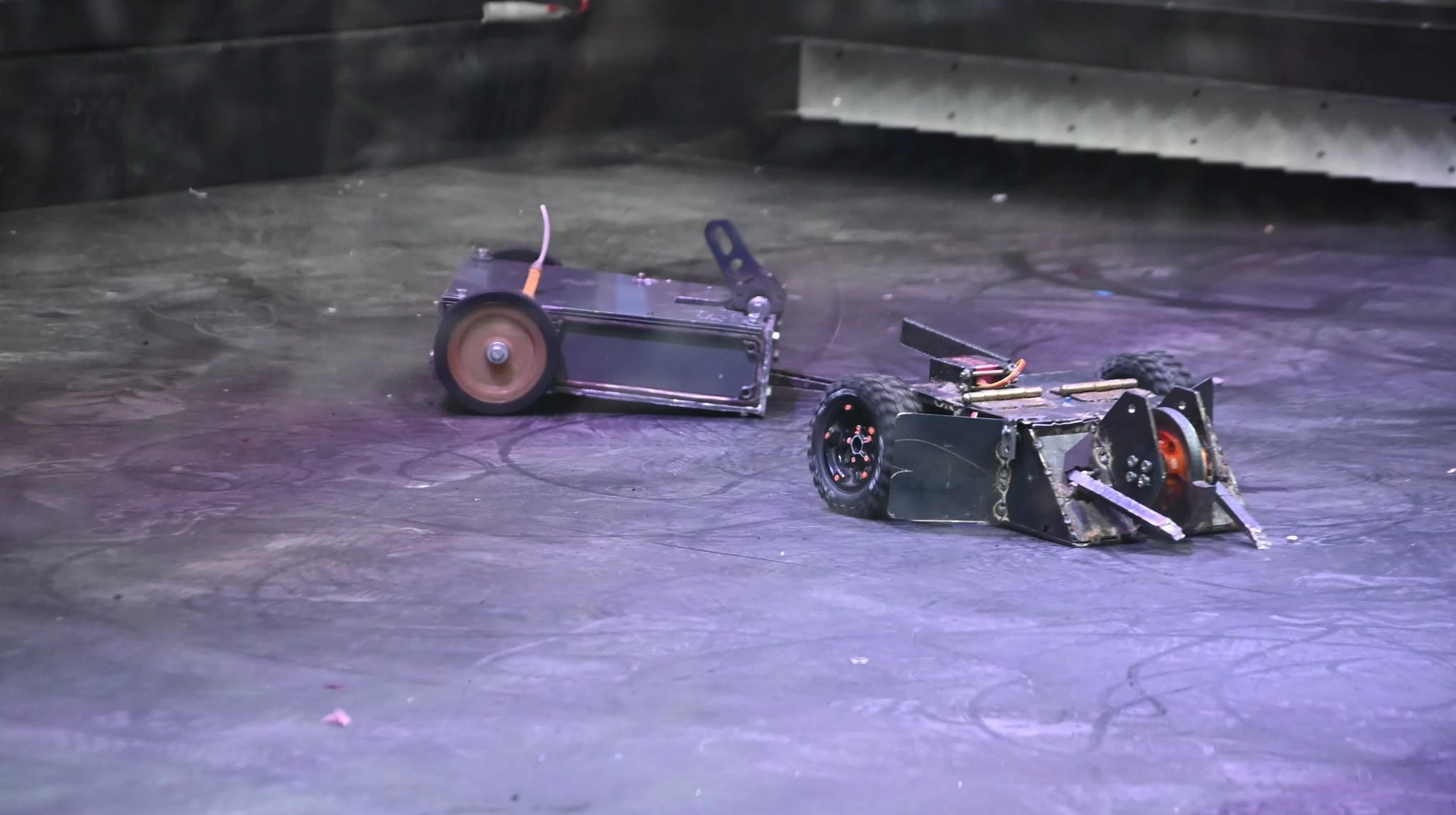
Designing a combat robot starts on paper
What must a combat robot be like? Tough enough to survive a three-minute fight, controllable enough to attack on purpose, and safe enough for one person to switch it on and off in seconds. All of this depends on decisions you make before you cut the first part.
Our article Combat robots: weight classes, teams and safety explains how the championship works. Here we go deeper into the practice of designing a combat robot: the main types, weapons, materials and the safety features that ROBO BATTLE 2026's rules require. If you have never built a robot, start with My first robot.
Design on paper is a real stage of the championship: in ROBO BATTLE 2026's rules teams hand in a sketch of the robot, its exact dimensions and materials, an interim technical review checks the build progress, and a week before battle day every robot passes a final technical and safety inspection (Tech Check).
The rules that shape a combat robot
Start from the rules, which shape everything else. In ROBO BATTLE 2026's rules:
- Weight classes (maximum weight): Antweight 500 g, Beetleweight 1.5 kg, Hobbyweight 5.4 kg, Featherweight 13.6 kg, Lightweight 27 kg. Antweight and Lightweight are pilot classes in 2026: whether they run depends on the number of teams and ready robots.
- An active weapon is mandatory — at least one, controlled separately from the drive. Armour, a wedge or another passive shape does not count; a robot without a working weapon is disqualified, so the rules advise a spare, modular weapon.
- The weapon needs its own power source, except in robots up to 5 kg, where one battery is enough.
- Movement must be controlled: only spinning on the spot does not count.
- The robot must fit the arena and its entrance; between fights parts may only be swapped for identical ones, and the chassis may not change.
- A fight lasts 3 minutes. If neither robot is disabled, judges score damage, attack and control — attacking only with armour or a passive weapon scores lower.
Each championship publishes its current rules on its page — check ROBO BATTLE 2026 before you commit to a design.
The main combat robot designs
The diagram shows the seven classic designs from the side (weapon in red):
- Wedge — a low ramp that slides under the opponent and lifts its wheels off the floor. Simple and tough, but passive: it must be paired with an active weapon.
- Pusher (rammer) — a strong, grippy box that shoves the opponent into the walls. It teaches driving, but it is passive too.
- Lifter — an arm or fork that lifts the opponent and takes away its traction. Great for control; it needs real torque.
- Flipper — a plate that fires upward and throws the opponent over. Spectacular, but it needs a lot of stored energy. Pneumatics are allowed only under strict limits (no CO₂, at most 200 bar stored and 25 bar working pressure, organisers' approval), and the rules ask inexperienced teams to choose another system.
- Horizontal spinner — a bar or disc spinning flat. Long reach and big hits, but the recoil throws your own robot around too.
- Vertical spinner — a disc spinning upward at the front, launching opponents into the air. Very effective, but the gyroscopic effect tips the robot sideways in turns.
- Drum — a short, heavy, toothed cylinder low at the front. Compact and stable — a popular first spinner in the Beetleweight class.
The organisers decide whether a weapon is strong enough to damage an opponent — a weak servo arm may not pass. Any mechanism the rules do not cover must be agreed with them in advance.
Spinner maths: tip speed, energy and the 300 km/h limit
In ROBO BATTLE 2026's rules no external moving part may exceed 300 km/h, and a rotating weapon must stop within 60 seconds from full speed or after the radio signal is lost. Check both on paper (the diagram):
- D — the weapon's diameter in metres.
- n — revolutions per minute (rpm). A brushless motor's no-load rpm is roughly KV × voltage; divide by the belt or gear ratio.
- Tip speed: v = π × D × n ÷ 60 (m/s); multiply by 3.6 for km/h.
- Spin-down time — measure it with a stopwatch; an ESC with braking helps.
Example: a 100 mm disc at 15,000 rpm has a tip speed of about 283 km/h — inside the limit. The same disc driven 1:1 by a 1400 KV motor on a fully charged 3S LiPo (12.6 V, about 17,600 rpm) reaches about 332 km/h — too fast. A 1.5:1 belt reduction brings it down to about 222 km/h.
Energy grows with the square of speed: twice the rpm means four times the energy — and four times the load on bolts, bearings and your own armour. Rotating weapons made of several parts or with removable teeth are approved by the organisers with drawings and calculations.
Materials and the weight budget
Weight is the currency of combat robot design. A common starting split (adjust it to your design):
- drive (motors, wheels, ESCs) — about 25–30 %;
- weapon (motor, belt, bearings) — 30–35 %;
- frame and armour — 25–30 %;
- battery, receiver, switches, wires — 10–15 %.
Leave a margin of a few percent: the official weigh-in happens before the event, and an overweight robot gets only limited time to fix it.
Typical materials: aluminium for frames; hardened steel for weapons and wedge edges; titanium if the budget allows; polycarbonate and UHMW-PE for armour that bends instead of cracking; in small classes, 3D-printed TPU (flexible, absorbs hits) or PETG / nylon. Avoid brittle PLA and acrylic for structure.
The rules allow metal, plastic and rubber but ban hazardous loose fibres (asbestos), polyurethane foam, radioactive materials and organic materials except wood and battery electrolyte. On the outside: no lead, no rubber-foam armour, no glass or brittle ceramics. Foam inside the robot and inside tyres is allowed — just make sure it is not polyurethane. Magnets (beyond those in motors, solenoids or relays) need permission in advance.
Safety designed in, not added later
These features decide where the parts go, so draw them into the first sketch (the diagram, top view):
- Frame and armour around everything.
- Weapon at the front, with room for a weapon lock — the rules require the weapon to be mechanically locked during transport.
- Drive motors and wheels, protected inside the frame.
- Battery in the centre: protected from impact and puncture, isolated from moving parts, unreachable through the outer shell. It comes out after every match.
- ESCs and receiver with failsafe: if the signal is lost or the transmitter is switched off, the drive and every weapon must stop by themselves — this is tested at inspection.
- At least two main switches — one cuts the drive, one cuts the weapon — reachable without lifting or flipping the robot and without touching the weapon, plus an easy-to-reach kill switch away from the weapon.
- Indicator lights that come on automatically with the main switch.
The rules also ask for power-on and power-off within 30 seconds by one person, with the robot standing still when switched on; no more than 60 V; and removable, mechanically fixed covers on sharp edges. Charge LiPo batteries with a balance charger, in a fire-safe bag, never unattended, and retire any swollen pack.
What next
Before you buy parts, run the design through a quick check:
- Class chosen; weight budget written down with a margin.
- Sketch with dimensions, top and side views; the robot fits the arena entrance.
- Tip speed under 300 km/h, spin-down under 60 seconds.
- Switches, lights and battery reachable; weapon lock planned.
- Spare parts identical to the originals, and a spare weapon.
ROBO BATTLE 2026 takes place in Tbilisi in November — see the championship page. The rules welcome spectators, and watching real fights is the fastest way to learn. Read how the first championship went — 92 teams registered — in ROBO BATTLE 2025. Practise motors and traction on a smaller project such as a SUMO robot. Every combat robot article is on the topic page; to volunteer or partner, see get involved.