En
En 
What radio control is and what it is made of
Radio control (RC) means driving a robot from a distance, by radio — that is how combat robots, RC cars and drones are driven. Autonomous robots, such as a SUMO robot or a line follower, make their own decisions.
A robot radio control system has four parts:
- the transmitter (TX) — the radio controller in your hands: sticks, switches and a radio module;
- the receiver (RX) — a small board in the robot that receives the commands;
- the actuators — motor controllers (ESCs) and servos;
- power — the battery and the main switch; the receiver is usually powered by a 5 V supply built into the ESC (the BEC).
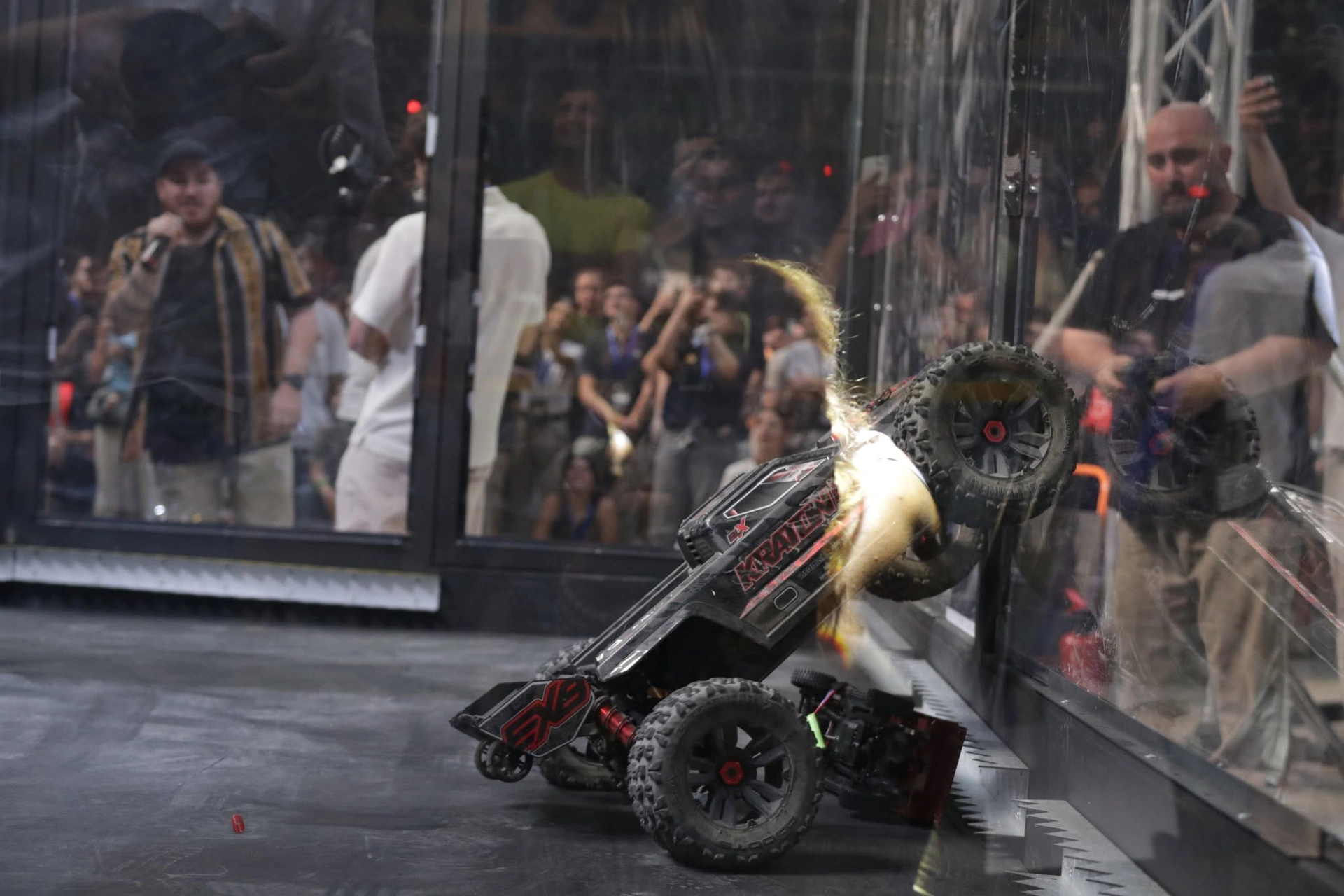
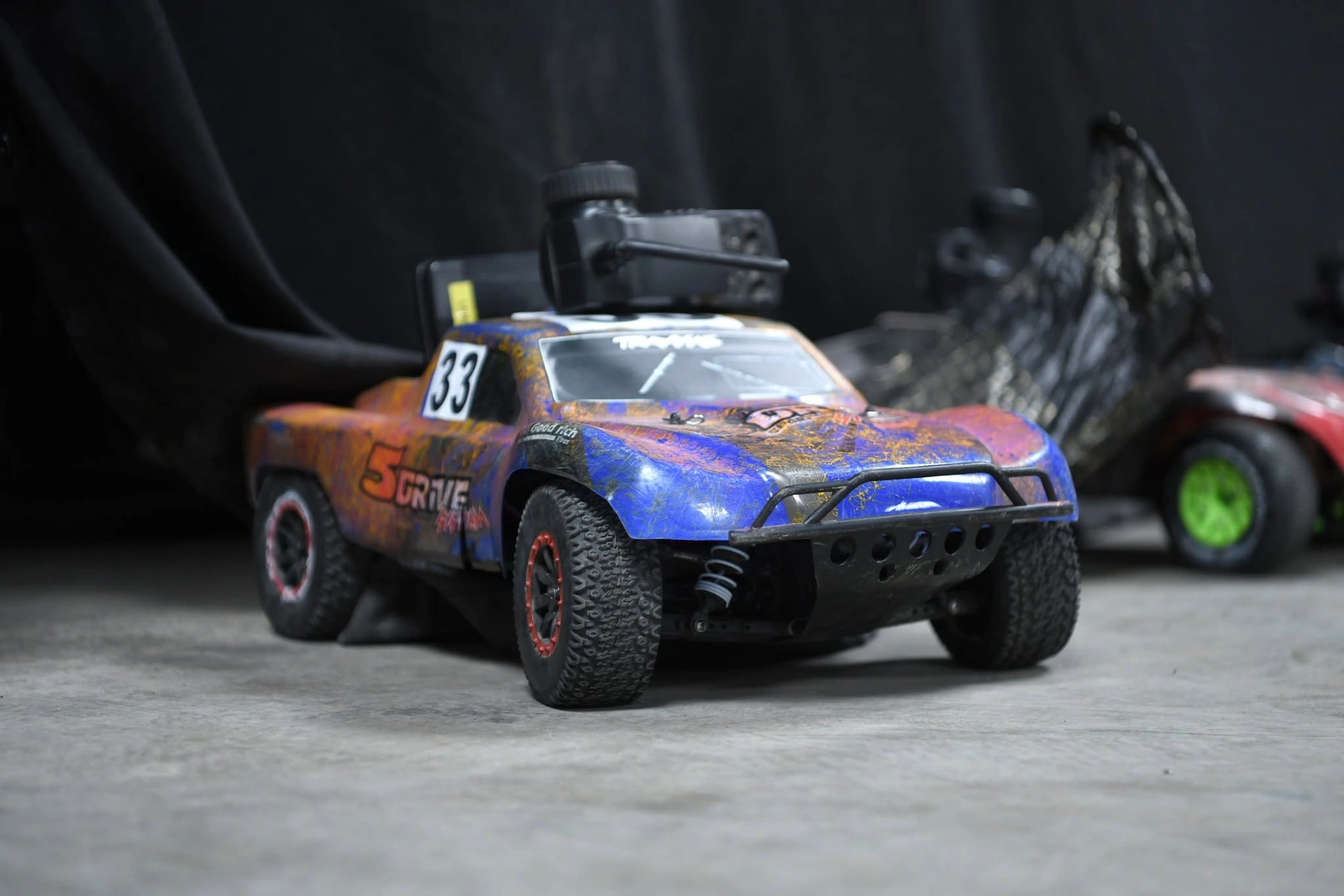
At the Georgian Robotics Association's events you'll see radio control at the ROBO BATTLE combat robot championship and at RC car races: RC races were part of ROBO BATTLE 2025, and on 20 June 2026 a separate RC car racing championship was held.
The parts of a radio controller: sticks, channels, receiver
A channel is one independent command: "forward–back", "left–right" or "weapon on". A stick drives two channels; every switch adds one more.
In the diagram:
- the transmitter: right stick — CH1 and CH2, left stick — CH3 and CH4, a switch — CH5 (the assignment can be changed in the menu);
- the 2.4 GHz radio link;
- the receiver: each channel has its own three-pin output;
- the left (L) and right (R) drive ESCs;
- the weapon ESC and motor;
- a servo (e.g. for a lifter or a flipper);
- the signal: one pulse every 20 milliseconds, 1000–2000 microseconds long (1500 = centre, "stop");
- three wires: signal (S), +5 V and ground (−); the +5 V comes from the ESC's BEC.
Driving takes 2 channels, a combat robot with a weapon 3–4; buy your first transmitter with 6 or more. If the robot has several ESCs with a BEC each, only one should power the receiver — disconnect the red (+) wire in the other leads, unless the ESC's manual says otherwise.
PWM, PPM, SBUS and CRSF in plain words
The receiver passes commands to the actuators in different "languages" — protocols:
- PWM — the classic servo signal (point 7 in the diagram), one wire per channel; almost every ESC and servo understands it.
- PPM — every channel's pulse one after another on a single wire; an old standard.
- SBUS and iBUS — a digital signal: many channels on one wire (up to 16 with SBUS). An ESC can't read it directly, but it is handy for a microcontroller (e.g. an Arduino).
- CRSF (ExpressLRS and similar systems) — a fast two-way digital link: telemetry comes back — signal strength, battery voltage.
If the receiver connects straight to the ESCs, choose PWM; if a microcontroller runs the robot (your own mixing, sensors), SBUS or CRSF on one wire is far easier. The transmitter and the receiver must use the same system (protocol).
Under the ROBO BATTLE 2026 rules, autonomous functions are allowed only if you can disable or cancel them remotely.
2.4 GHz, binding and frequencies
Modern sets work at 2.4 GHz and change frequency many times a second (frequency hopping), so many transmitters can share one hall.
Binding pairs a receiver with one particular transmitter: put the receiver in bind mode, choose bind on the transmitter, and the receiver's light stays on — now it listens only to your transmitter.
- Give every robot its own model in the transmitter's memory (reversing, mixing, failsafe) and check the right one is selected before you drive;
- route the receiver antennas out of a metal body, at 90° to each other and away from the motor wires; an antenna holder is easy to print — see the 3D printing guide;
- do a range check before a competition.
Under GRA's ROBO BATTLE 2026 rules your system must not interfere with other teams' systems, especially on similar frequencies — that is the team's responsibility. RC systems are checked before the competition; interference, or failing to show the system is reliable, may lead to disqualification. An extra antenna or base station gets 60 seconds to set up and 60 to remove.
Tank steering: mixing for two motors
Most combat robots — and SUMO robots too — have no steering: separate motors drive the left and the right wheels, and the robot turns by running them at different speeds (tank steering). To drive it with one stick you need mixing: the "forward" (T) and "turn" (S) commands are shared between the motors: left L = T + S, right R = T − S.
In the diagram:
- the stick position;
- the motor commands (+100 = full forward, −100 = full reverse);
- the motion: forward, an arc to the right, a spin on the spot, reverse, stop;
- the formula.
Mix in one place only — the transmitter, a dual ESC or a microcontroller — or the robot moves unpredictably.
Setting it up, with the robot on a stand and the wheels in the air:
- stick forward — both wheels turn forward (if not, reverse that channel);
- stick right — left wheel forward, right wheel back;
- stick centred — the wheels stand still (adjust the trim if needed);
- soften the turning with dual rate and expo.
For a robot that also drives upside down, set a switch that reverses the controls.
Failsafe: what happens when the link is lost
Failsafe is what the receiver does when it loses the signal — a flat transmitter battery, a switched-off transmitter or too much distance:
- hold the last command — the most dangerous: the robot keeps going (✗);
- preset values — drive to "centre", weapon to "off" (✓).
In the diagram:
- the signal is lost or the transmitter is off;
- hold: the motor keeps turning;
- failsafe: the drive goes to centre (1500 µs) and the robot stops;
- the weapon is switched off and spins down — at ROBO BATTLE within 60 seconds at most.
Set the failsafe as the manual says and always test it: robot on a stand, weapon removed or locked; run the motors slowly and switch the transmitter off — everything must stop.
Under GRA's ROBO BATTLE 2026 rules:
- if the signal is lost, the transmitter is switched off or the control system loses power, the drive and all active weapons must automatically go to a safe, disabled state — this is tested at the technical inspection;
- a spinning weapon needs an emergency shutoff for loss of RC signal and must stop from full speed within 60 seconds;
- at least two main switches (drive and weapon) and an easily reached Kill Switch away from the weapon are required; one person must switch the robot on or off within 30 seconds, it must not move when switched on, and a light must show the power is on.
The Tech Check a week before the event covers weight, control, failsafe, the weapon, the weapon lock and the power system.
Choosing your first radio controller
Check that the set has:
- 2.4 GHz and 6 or more channels;
- failsafe on every channel, with preset values — this matters most;
- memory for several models, mixing, reversing, dual rate / expo;
- receivers sold separately — one for each robot;
- ideally telemetry (battery voltage on the screen).
Pistol-grip transmitters (a wheel and a trigger) are common for RC cars; for a combat robot a two-stick transmitter is easier. Control from a phone over Bluetooth or Wi-Fi is fine for a classroom robot, but not for an arena: when the link is lost the robot must stop predictably, and at ROBO BATTLE you must show your RC system is reliable.
For the RC car championship, GRA's 2026 rules say the information will be given on site — ask the organisers about the details in advance. Every championship publishes its current rules on its page.
LiPo batteries: charge only with a balance charger, in a fireproof bag and under supervision; never use a swollen battery; unplug the battery while you work on the robot.
What next
- the full wiring from the battery to the receiver — How to build a combat robot; safety and design types — What a combat robot must be like;
- receiver and antenna holders — 3D printing a robot;
- ROBO BATTLE 2026 takes place in November 2026, international for the first time and open to spectators;
- past championships: ROBO BATTLE 2025, RC car racing championship 2026;
- events — on the events page; every article about radio control — on the tag page.