En
En 
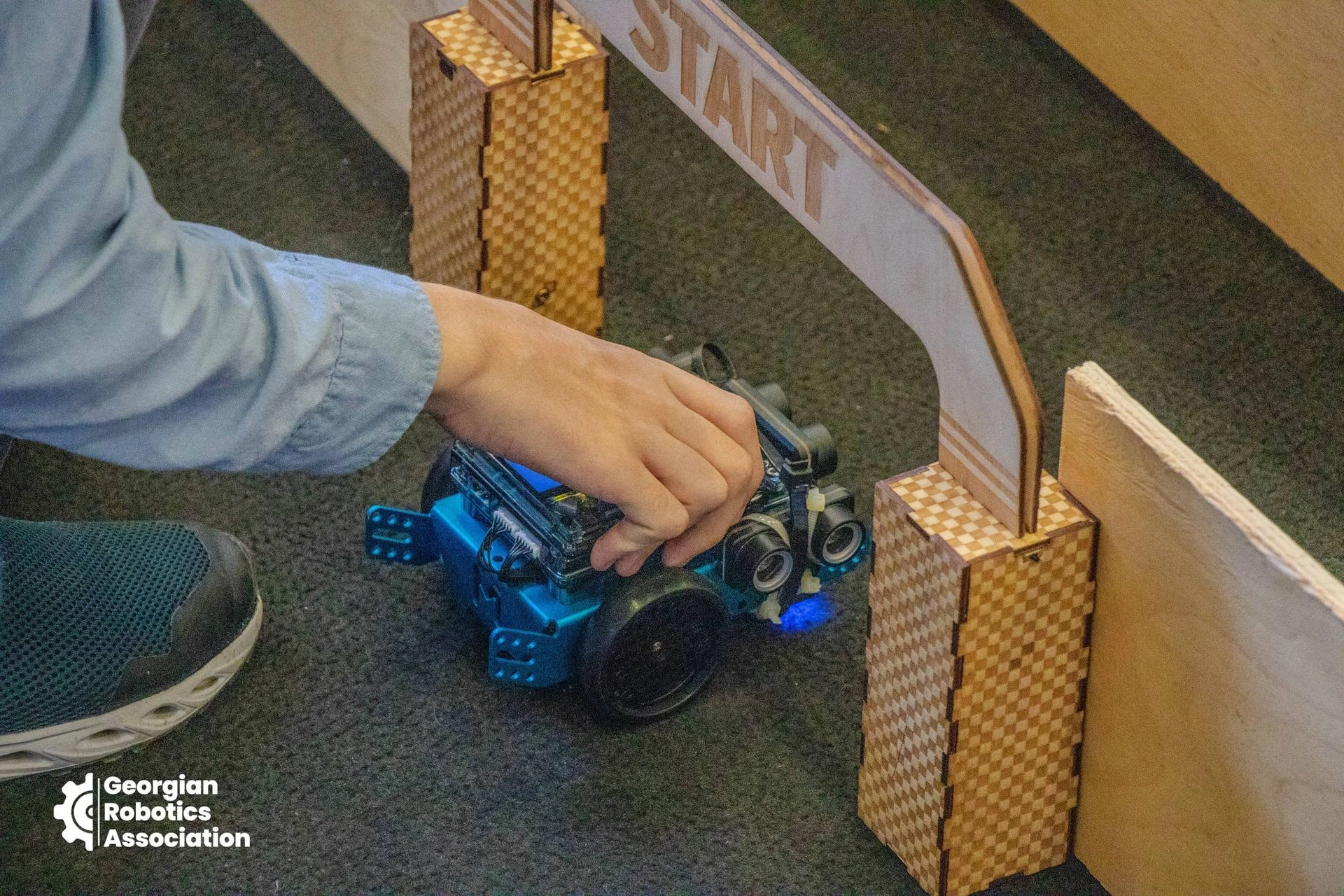
Where line follower robots compete
A robotics competition for line followers is easy to watch and hard to win: the robot has to follow the line to the end, on its own, in the shortest time. The Georgian Robotics Association (GRA) runs two such competitions:
- the School Robotics Competition — for school teams; in 2026 it had two categories: I — zigzag (line following) and II — labyrinth;
- the Georgian Robotics Championship in SUMO and Line Follower — for older pupils, students and anyone interested.
This guide sums up the line follower robot rules as GRA's 2026 rules set them, and always says which competition a rule comes from: the school competition (zigzag and labyrinth) or the championship (SUMO and Line Follower). Rules change from year to year — each championship publishes its current rules on its own page: School Robotics Competition, SUMO and Line Follower. How to build the robot itself — building a line follower step by step.
The school competition: the robot and the start
In GRA's 2026 school competition rules both categories set the same requirements for the robot:
- weight — no more than 1 kg;
- size — the robot must fit in a 180 × 280 mm box;
- start button — the robot must have a "start" button and must start moving within 5 seconds of it being pressed;
- timing — the clock starts when the robot crosses the start line and stops when it crosses the finish line;
- autonomy — remote control of the robot during the competition is not allowed;
- one member — in each category only one member of the team comes out to the arena with the robot;
- for the zigzag, you send the robot's size and weight when you register.
The safety rules forbid shockers and electromagnetic jammers, and anything that damages the stage surface: devices that give off fire or smoke, liquids, powders, sprays, ropes or nets, and launching devices.
A tip: cut a 180 × 280 mm box out of cardboard and put the robot in it, and weigh the robot with its battery — weeks before the competition, not on the day.
Category I — the zigzag: track, attempts, scoring
The zigzag is the classic line following task. In GRA's 2026 school rules:
- robots run the course one at a time;
- each robot has 2 attempts; the better result counts;
- the line may be black or white, on a contrasting background; it is 1.6 cm wide;
- the picture in the rules is only an example — a different type of track may be used at the competition;
- the robot must cover the whole route and must not skip any part of the line — otherwise it is disqualified;
- the winner is the robot that completes the full route in the shortest time;
- a jury scores the teams; speed and precision decide, and if the robot strays from the line, its time is automatically annulled (the rules say "reset to zero").
In the diagram (an example, not the real track): 1 — start line; 2 — the line, 1.6 cm, black on white or white on black; 3 — finish line; 4 — the robot: ≤ 1 kg, fits in a 180 × 280 mm box; 5 — the start button: moving within 5 s; 6 — two attempts, the better time counts.
In practice this means precision first, speed second. A robot that cuts a sharp corner of the zigzag skips part of the line — and a disqualification costs more than a slow run. Practise on tracks of different shapes and on both line colours.
Category II — the labyrinth
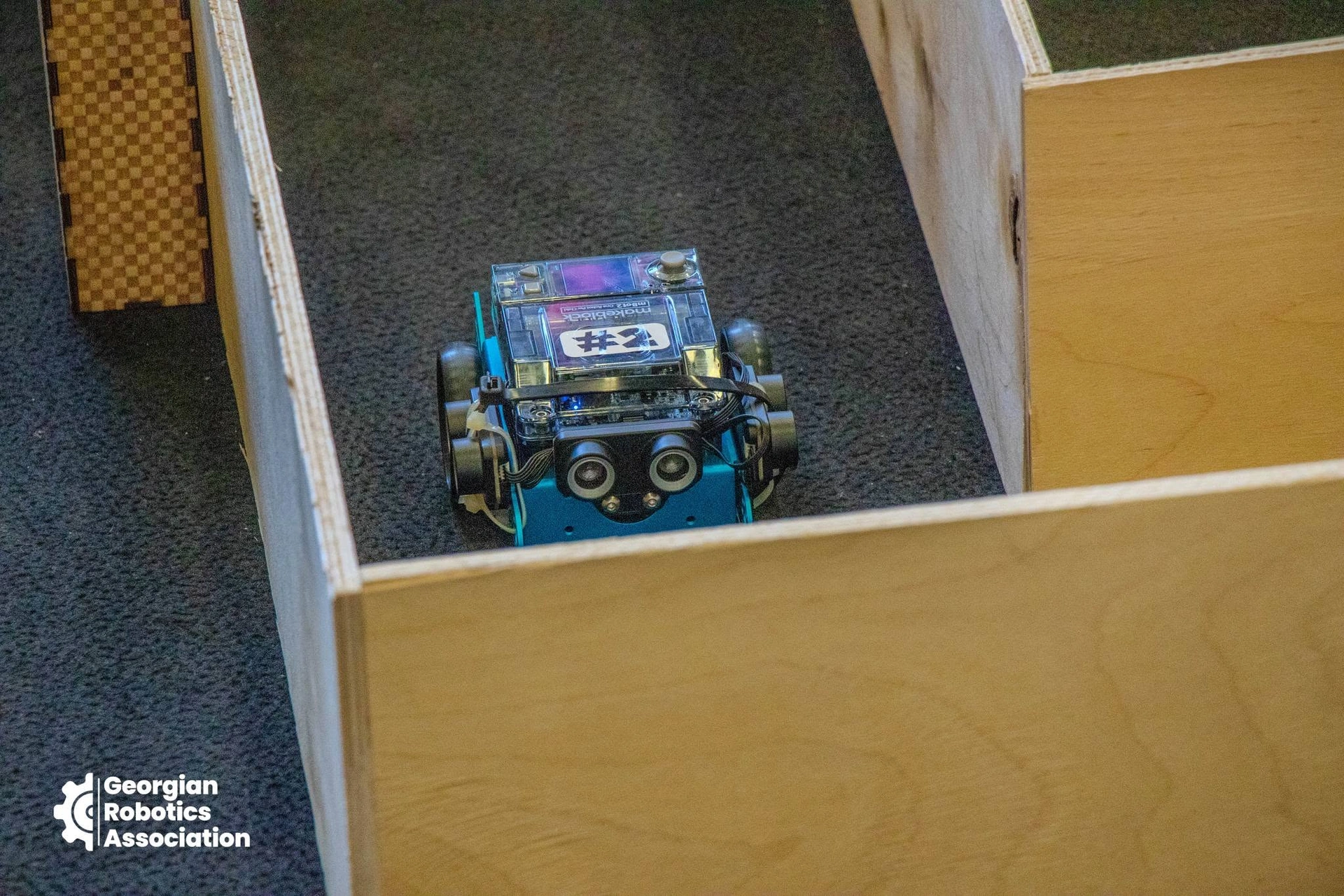
In GRA's 2026 school rules, the labyrinth category (for 4WD/2WD robots) has:
- the same robot limits as the zigzag (≤ 1 kg, 180 × 280 mm), the same start button (moving within 5 s) and the same timing (start line to finish line);
- corridors 30 cm wide; the robot has to find its own way from the start point to the exit;
- a time limit of 3 minutes; a robot that takes longer to get through automatically loses;
- 2 attempts, the better counts; the shortest time wins; a jury scores the teams;
- a different labyrinth at the competition from the one in the rules' picture;
- no remote control, and the same safety rules.
In the diagram (an example): 1 — start; 2 — a corridor, 30 cm; 3 — exit; 4 — the time limit, 3 minutes; 5 — only one team member at the arena; 6 — two attempts, the better time counts.
At the 2026 competition one robot had to complete both categories (the 2026 report), so plan a robot with line sensors underneath and distance sensors at the front and sides. A simple, reliable labyrinth method is following one wall (for example, always the right-hand one) — more in our school robotics guide.
The Georgian Robotics Championship: Line Follower and registration
The Georgian Robotics Championship, organised by GRA, is held in two categories: SUMO and Line Follower. In 2026 the Line Follower category was Line Follower Classic: robots up to 3 kg that fit in a 30 × 30 cm box — as our 2026 championship report records; the robots acted on their own, and remote control was not allowed. The detailed Line Follower rules (track, line, timing) are published on the championship page — read the current version before you design your robot. And the winners got more: in 2026 the three winning SUMO and Line Follower teams earned the right to represent Georgia at the European championship.
Registration, as GRA's 2026 championship rules set it for SUMO and Line Follower:
- One team member fills in the online application form and chooses the category.
- Selection has two stages: after the forms are reviewed, registered participants receive an information email; in the second stage the selected teams' robots are checked, and after the final confirmation the teams prepare for competition day.
- A team pays a participation fee for each category it enters (in 2026, 50 GEL); after payment a confirmation email arrives, and registration counts as complete only once the payment is confirmed.
- If a team can no longer take part, it must tell the organisers in writing (by email); the fee is refunded only if this happens before the official registration deadline — after the deadline it is not.
How to prepare a team for a school championship
A school robotics championship is won in the weeks before it. A plan that works:
- Team and roles. At the 2026 school competition a team had 2–5 pupils from grades 7–12, and a school could register several teams (report). Give everyone a role: builder, programmer, tester with the stopwatch, and a captain who knows the rules by heart.
- Read the rules together — the current version is on the competition page — and turn them into a checklist.
A timeline:
- 8–10 weeks before: the robot is built, sensors and motors work, size and weight are within the limits.
- 6 weeks before: the robot follows the line reliably with P or PID control (see the build guide).
- 4 weeks before: the labyrinth works; the robot starts moving within 5 seconds of the button press.
- 2 weeks before: full rehearsals — both tasks, two attempts each, a stopwatch, one member at the "arena".
- The last week: no big changes; spare parts, charged batteries, a backup of the code.
On the day: calibrate on the real track; make the first attempt a safe one — the better result counts, so the second can take more risk; and keep the robot's settings written down.
What next
- Build the robot — building a line follower step by step; the basics — my first robot; another autonomous robot — how to build a SUMO robot and SUMO competitions for beginners.
- For school teams — how to start robotics at school and the 2026 school competition.
- Current rules and registration — the School Robotics Competition and SUMO and Line Follower; every competition and upcoming events.
- Want to help as a volunteer, mentor or partner — get involved.
- Every post on this topic — line follower.