En

Introduction
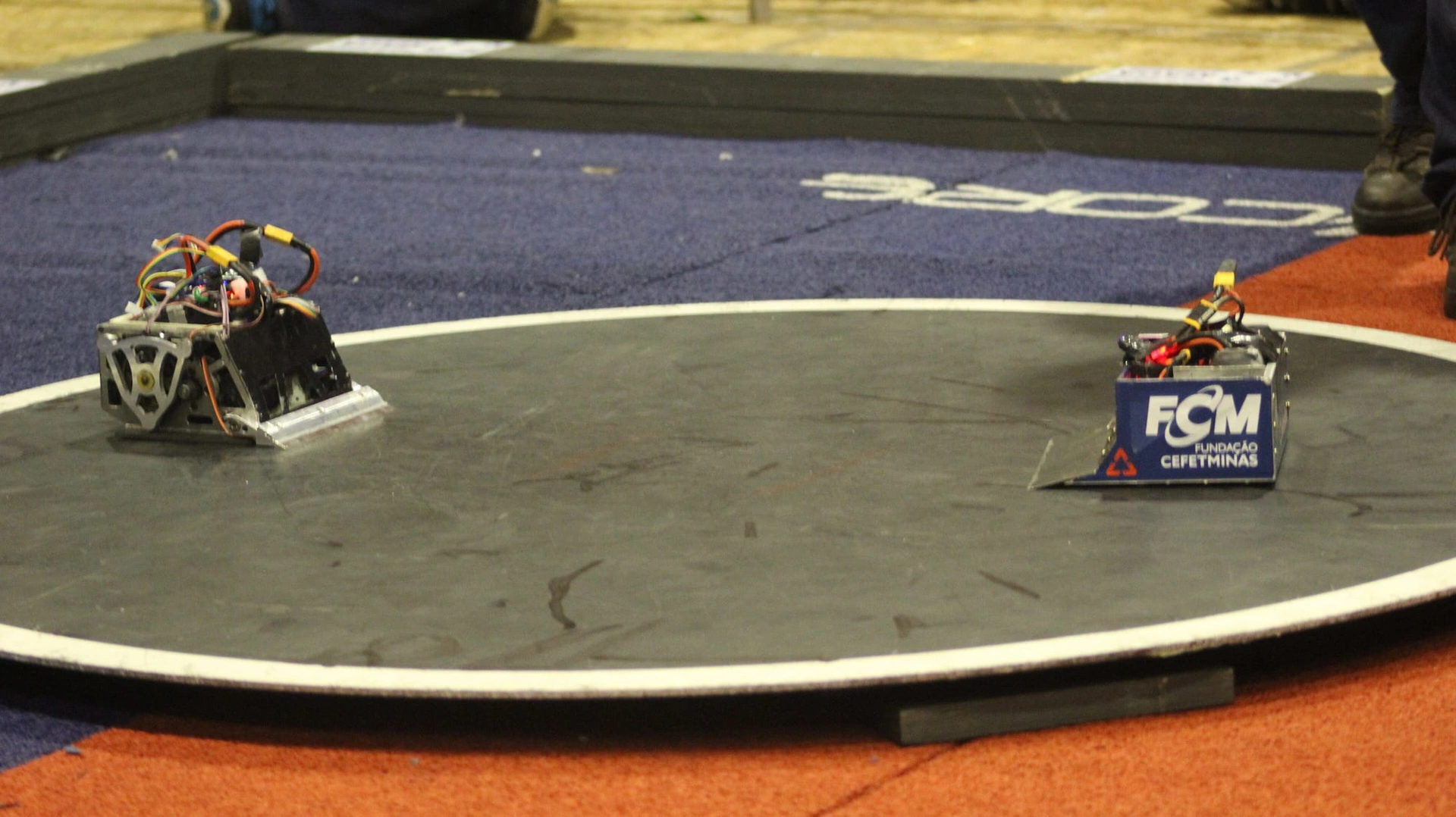
Mega Sumo: the 3 kg class of robot sumo
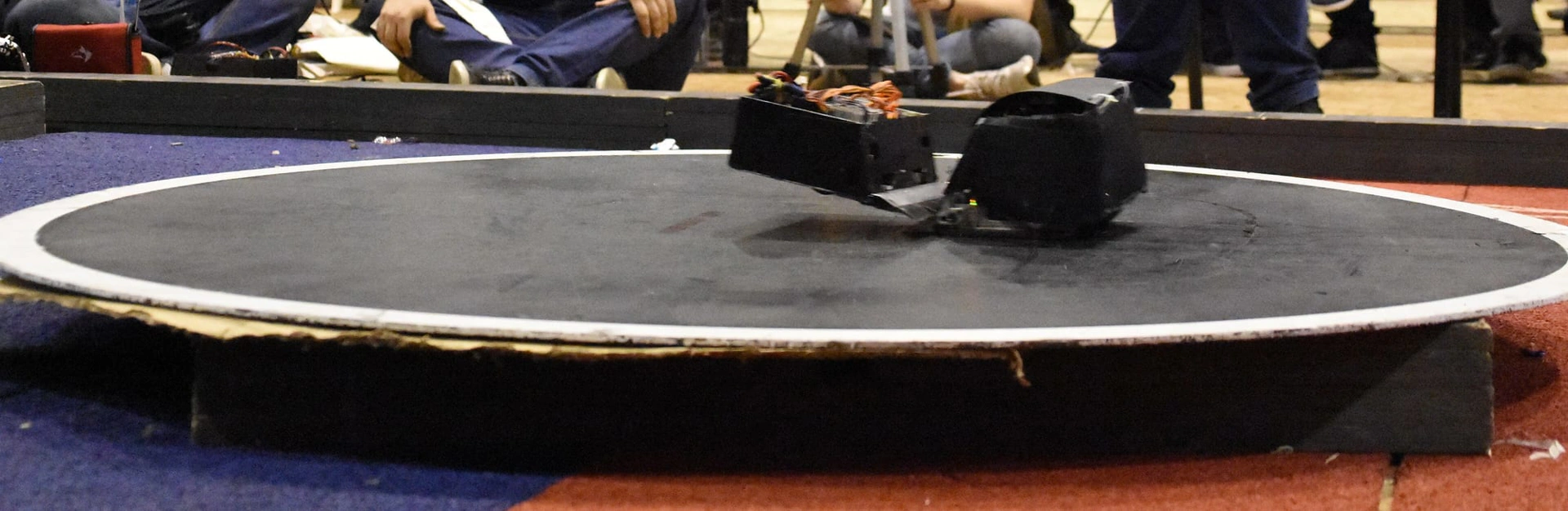
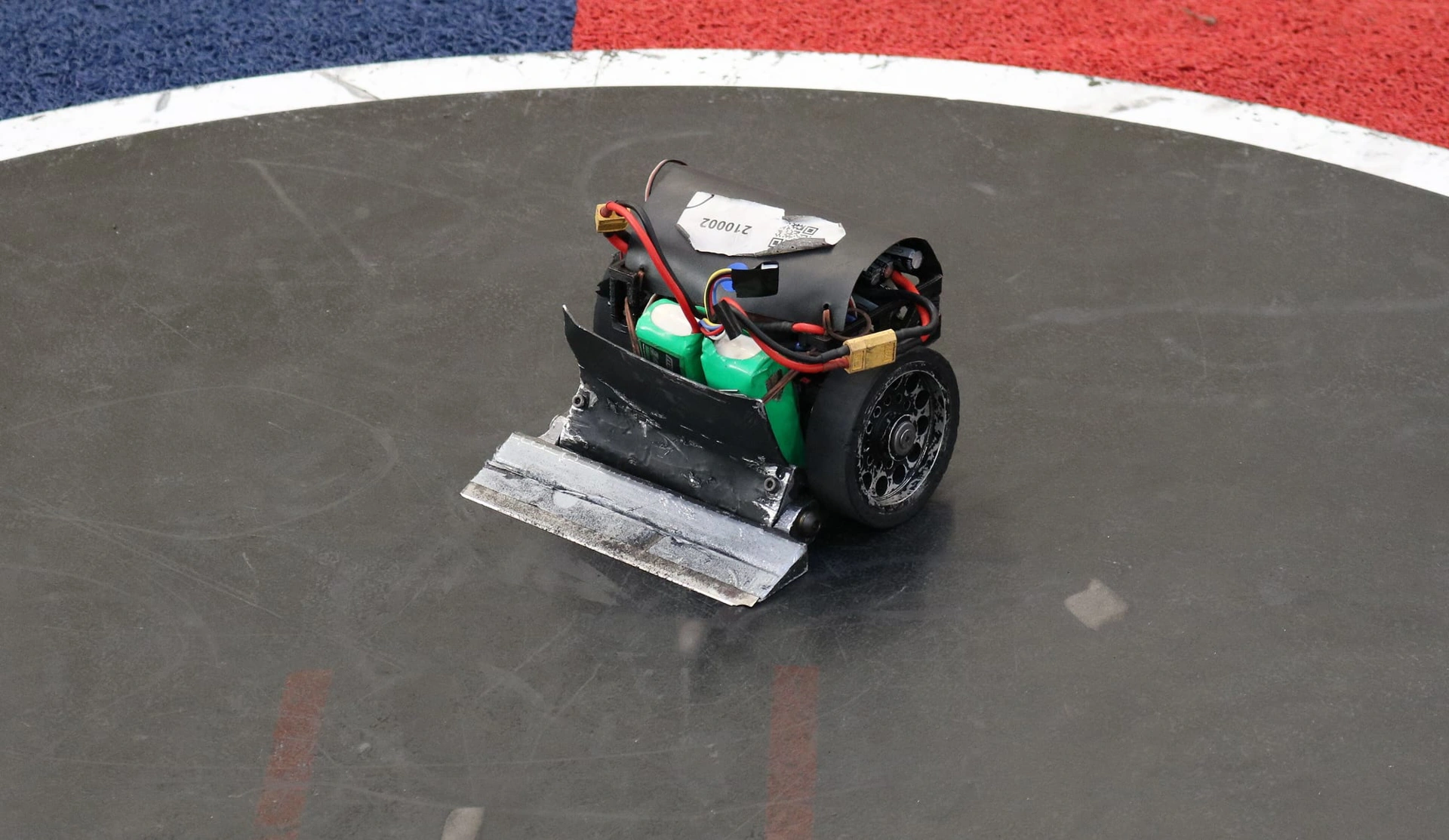
Mega Sumo is the oldest and heaviest class of robot sumo. The robot must fit inside a 20×20 cm square, weigh less than 3 kg and fight fully autonomously. Two mega sumo robots meet on a 154 cm steel ring, which is why, unlike Mini Sumo, magnets are allowed. The first robot to score two points (Yuhkoh) wins the match.
Born in Japan, where FUJISOFT held the first robot sumo tournament in 1989 with 3 kg robots, the class now headlines big European events like RoboChallenge in Bucharest.
For us, 2026 makes this class special: on 20 June the team RageByte won Mega Sumo at our STEAM and Robotics Championship of Georgia in Tbilisi and now represents the country at RoboChallenge 2026. All the winners are in our article on Georgia’s Robotics Championship 2026.
This article is only about the 3 kg class: its rules, the steel ring, magnets, powerful motors and our champion. If robot sumo is new to you, start with Robot sumo: what it is and how to prepare; the general steps of building a sumo robot are in our step-by-step sumo robot build guide.
What is Mega Sumo and how is it different from other classes?
Classes differ by robot size, mass and ring (the dohyo). Official RoboChallenge 2026 numbers:
- Mega Sumo: robot 20×20 cm, height free; under 3 kg; steel ring, 154 cm; downforce devices allowed.
- Mini Sumo: robot 10×10 cm, height free; under 500 g; wooden ring, 77 cm; downforce devices banned.
- Micro Sumo: robot 5×5×5 cm; under 100 g; wooden ring, 38.5 cm; downforce devices banned.
- Nano Sumo: robot 2.5×2.5×2.5 cm; under 25 g; wooden ring, 19.25 cm; downforce devices banned.
The key difference is the ring: a 5 mm black steel disc with a 5 cm white border, on a 5 cm wooden base. Magnets stick to steel, so RoboChallenge explicitly allows magnets, electromagnets and vacuum pumps in Mega. Mini Sumo bans downforce devices such as EDF fans or suction pumps, and its ring is wood, where a magnet would not help anyway.
A robot that fits a lower class cannot enter Mega Sumo. A separate Mega Sumo RC class is driven by remote; this article covers the autonomous one. For 500 g robots, read our Mini Sumo robot guide.
Mega Sumo rules: RoboChallenge vs our championship
RoboChallenge’s Mega Sumo 3kg (auto) rules in short:
- at homologation (technical inspection) a 20.3×20.3 cm frame goes over the robot and the scale limit is 3005 g;
- it may expand after the start but must stay in one piece; a dropped part lighter than 20 g does not lose the match;
- a referee-operated infrared start/stop module is mandatory;
- jammers, liquids, powders, gases, flames and thrown objects are banned;
- the blade must not be white and stays covered off the ring;
- operators and assistants wear gloves and safety glasses during the match;
- three referees run each match.
Our association used very similar Mega Sumo rules in 2026, with a few differences:
- Mass: under 3 kg at RoboChallenge 2026; 0.5–3 kg at our championship.
- Ring: steel, 5 mm, 154 cm at RoboChallenge; steel, 3–5 mm, 154 cm with us.
- Robot placement: behind 20×2 cm start lines at RoboChallenge; in opposite quadrants, on the white border with us.
- Kill switch: recommended at RoboChallenge; mandatory with us.
- Match: 3 rounds in 3 minutes total at RoboChallenge; 3 rounds, 5 in the final with us.
Both rulebooks require full autonomy and an IR start module, and both allow magnets. Our championship was open to everyone from age 14, school teams included, in teams of 2–5. The full SUMO and Line Follower rules are in our article Georgia’s Robotics Championship 2026: SUMO and Line Follower. Rules change yearly, so always read the current rulebook. More on how the national team got to Bucharest: Georgia at RoboChallenge 2026.
How a match works: homologation, IR start and Yuhkoh points
- Homologation: size, mass, start module, blade cover and safety gear are checked at the start of the group and before every match.
- Placement: the robot goes behind the start line, the blade cover comes off, and nobody touches it again.
- Start: the referee sends an IR signal and both robots move at once, with no countdown.
- Fight: you score a Yuhkoh when the opponent is pushed out, leaves the ring by itself, or is too damaged to continue. The white border counts as inside.
- End: first to two Yuhkoh wins; if time runs out, one point is enough. On a tie, the referees may call a 3-minute extension where the first point decides.
The start module speaks the standard RC-5 infrared protocol. Per our rulebook appendix, address 0x0B is the programming command that sets which ring it listens to, and 0x07 carries start and stop (last bit 1 = start, 0 = stop). The module keeps its state in non-volatile memory, so it returns to the last state after a reset and every match must end with the referee’s Stop. A kill switch (usually a relay) cuts motor power on Stop.
No battery swaps, repairs or reprogramming are allowed during a match; between rounds there is only a one-minute break for cleaning and wheel care. Choosing a tactic before the fight does not count as reprogramming, so good robots have a tactic selector such as a DIP switch.
How to build a mega sumo robot: chassis, blade and centre of gravity
The general order of building a sumo robot is covered step by step in our sumo robot build guide. Here we focus on what sets the 3 kg class apart.
Start with a 3 kg weight budget for chassis, motors, battery, magnets and blade.
- Chassis: a rigid metal frame. One open design on Instructables uses CNC-machined 7075 aluminium with 3D-printed covers and mounts (ABS or PETG).
- Blade: thin steel across the full front, its edge on the ring so it slides under the opponent (200×23×2 mm in that project).
- Centre of gravity: battery, motors and magnets as low as possible; a low robot is hard to tip and gives the opponent’s blade less of a chance.
- Toughness: 3 kg robots hit hard, so use threadlocker on screws, tie the wires down and keep sensors behind the blade.
Motors, wheels and magnets: where the pushing force comes from
The robot whose wheels slip last usually wins. Maximum push is roughly friction coefficient times the force pressing the robot onto the ring: about 29 N for a 3 kg robot without magnets. With magnets, per Wikipedia’s Robot-sumo article, many robots exceed 100 kgf (about 980 N), roughly 30 times more grip in theory with the same tyres.
That has two consequences. First, the motors must be strong enough to use that grip. Brushed DC gearmotors are most common, some teams use brushless, and Maxon and Faulhaber are popular at the top. On a budget, the Instructables project uses Mabuchi RZ-735 motors, about a tenth of a Maxon’s price according to its author. Second, the currents are large: the same project uses a 100 A motor driver, an 80 A fuse and XT60 connectors. RoboChallenge allows fuses, and a blown fuse may be replaced between rounds.
The gear ratio trades force for speed: more reduction gives more force, but the robot reaches the opponent more slowly. Choose it together with wheel diameter, motor, battery and magnets.
Tyres: adhesives are banned, which is checked with the A4 test: nothing touching the ring may lift and hold a standard A4 sheet (80 g/m², about 5 g) for over 2 seconds. Grip has to come from the rubber and the magnets, not glue.
Magnets: strong magnets in the base and blade mounts double as ballast, turning mass you would have to add anyway into useful force. But a robot clamped hard to steel turns less easily, so tune magnets, motors and wheel layout together.
Sensors and code: finding the opponent and start tactics
Autonomous sumo robots usually find the opponent with infrared or ultrasonic distance sensors, often arranged in a fan (several at the front, one on each side) so the robot knows which way to turn, and see the white border with downward-facing reflective sensors (phototransistors). Our rulebook adds a tip: switch 38 kHz sensors on only after the start signal so they do not disturb the start module.
The program is a state machine: wait for the start, run the chosen opening, search, attack, and back off at the white border. On an Arduino, the main loop does this on every pass (you write the helper functions for the motors and sensors):
- Read the start module output. If the signal has not arrived yet, or the referee has sent Stop, stop the motors and stay in the waiting state.
- As soon as the start signal arrives, run the opening tactic chosen before the fight with the DIP switch, with no delay.
- Check the edge sensors on every pass. The white border beats everything: if the robot sees it, it backs off, turns and goes back to searching.
- After the opening, search for the opponent, for example by spinning on the spot.
- When a distance sensor sees the opponent, charge at full speed; if the opponent is lost, go back to searching.
If programming an Arduino is new to you, start with our Arduino for beginners guide.
Common opening tactics:
- Straight attack: full speed when the opponent is face to face;
- Flank: an arc to hit the opponent’s side, where it has no blade;
- Wait: hold blade-first and let an aggressive opponent run onto your blade;
- Feint: a short move to one side, then a quick turn and attack to confuse the opponent’s program.
Watch the opponent’s opening in round one, then pick a different tactic for the next.
Safety: LiPo batteries, sharp blades and strong magnets
A Mega Sumo robot packs several hazards into one box, so always follow these rules:
- LiPo batteries: quality charger, balance lead connected, a LiPo safety bag, never unattended. Let hot packs cool before charging, never go below 3.0 V per cell, store at about 3.8 V, retire puffed packs.
- Blade: always covered off the ring; at RoboChallenge this is mandatory, and after two violations the opponent gets a point. Operators must wear gloves and glasses there.
- Magnets: the robot snaps onto steel tables and tools; lift it with both hands, fingers clear of the base and blade.
- Motors: test on a stand, wheels in the air, kill switch in use even at home.
- Travel: flying with LiPo packs falls under airline and international air transport rules; check them first.
How to prepare a mega sumo robot for homologation
- Weigh it fully assembled, with battery and flags: under 3 kg.
- Check the size with a home-made 20×20 cm plywood frame.
- Test the start module: Start, Stop and behaviour after a reset.
- Run the A4 test on every tyre.
- Make sure the blade is not white and the cover is packed.
- Pack the operator’s gloves and safety glasses.
- Fix the organiser’s robot number where it is clearly visible.
- Pack spare fuses, charged batteries and a clean cloth for the tyres.
Practical tips
- Calibrate edge sensors on the real ring: hall lighting and the shine of the black paint differ from home.
- Practise on a steel sheet to feel what the magnets really do.
- Label the tactic switch and make checking it part of your routine every time you place the robot.
RageByte: Georgia’s Mega Sumo champion at RoboChallenge 2026
On 20 June 2026 in Tbilisi, our association held the STEAM and Robotics Championship of Georgia (championship report). The Mega Sumo category was won by RageByte: Dachi Nazrishvili, Eto Chakhvashvili, Misho Kalandarishvili and Nini Gotsadze.
The win earned them the right to represent Georgia at RoboChallenge 2026, held from 30 October to 1 November at POLITEHNICA Bucharest. This is the first time a Georgian national team takes part in RoboChallenge. RageByte competes in Bucharest under the rules described above: steel ring, IR start, three rounds and two Yuhkoh points. The competition is still under way as we write; official results will come from the organisers.
The other two teams and their categories feature in our Mini Sumo robot and line follower robot articles. To find out how you can help the team, read Georgia’s national robotics team at RoboChallenge 2026: how to help.
Frequently asked questions
How much can a mega sumo robot weigh?
Under RoboChallenge rules, less than 3 kg (the homologation scale allows 3005 g), inside a 20×20 cm square, with no height limit. At our 2026 championship the Mega Sumo range was 0.5–3 kg.
Are magnets allowed in a sumo robot?
In Mega Sumo, yes: RoboChallenge and our championship rules allow magnets, electromagnets and vacuum pumps, because the ring is steel. Mini Sumo bans downforce devices, and on its wooden ring a magnet would not work anyway.
What is the difference between Mega Sumo and Mini Sumo?
Mega Sumo: 20×20 cm, up to 3 kg, 154 cm steel ring. Mini Sumo: 10×10 cm, up to 500 g, 77 cm wooden ring. Mega’s magnets mean far bigger forces and currents, so Mini is the easier start for beginners.
How do I start building a sumo robot?
Start with Arduino and a simple car: two motors, a driver, a distance sensor and two edge sensors. First teach it never to drive off the ring by itself, then add opponent search. For parts and build steps, see our sumo robot build guide; if this is your very first robot, read My first robot: learning robotics from scratch.
Can a mega sumo robot be remote-controlled?
Not at our 2026 championship: remote control was banned and the robot does everything with its own program. RoboChallenge runs a separate Mega Sumo RC class, next to the autonomous one, where an operator drives the robot by remote.
What is the minimum age for Georgia’s robotics championship?
Our 2026 SUMO and Line Follower events were open from age 14, including school teams, in teams of 2–5. The conditions are renewed every year, so keep an eye on our competitions page.
Next step
Mega Sumo combines mechanics, electronics, soldering and programming, so the road starts small: Arduino, motors, sensors, a first autonomous car. For the basics, see Electronics basics for robotics and Robot sumo: what it is and how to prepare.
The best practice is a real competition. Take part in our competitions: the next event is ROBO BATTLE 2026, from 21 to 28 November. What to expect and how to prepare is in our ROBO BATTLE 2026 guide. For RageByte’s and the whole national team’s results from RoboChallenge 2026, follow us on Facebook.
Sources
- Mega Sumo 3kg (Auto) Regulation, RoboChallenge
- Mini Sumo Regulation, RoboChallenge
- SUMO and Line Follower 2026: rules and registration, Georgian Robotics Association
- Georgia’s national robotics team at RoboChallenge 2026, Georgian Robotics Association
- Robot Start Module, p1r.se
- Robot-sumo, Wikipedia
- 3DP and CNC Create a Mega Sumo Robot With Mabuchi Motors, Instructables
- Lithium Polymer Battery Use Checklist, University of Pennsylvania EHRS
Photos (cover and the 3 kg robot on the ring): Trsumo, CC BY-SA 4.0, Wikimedia Commons.